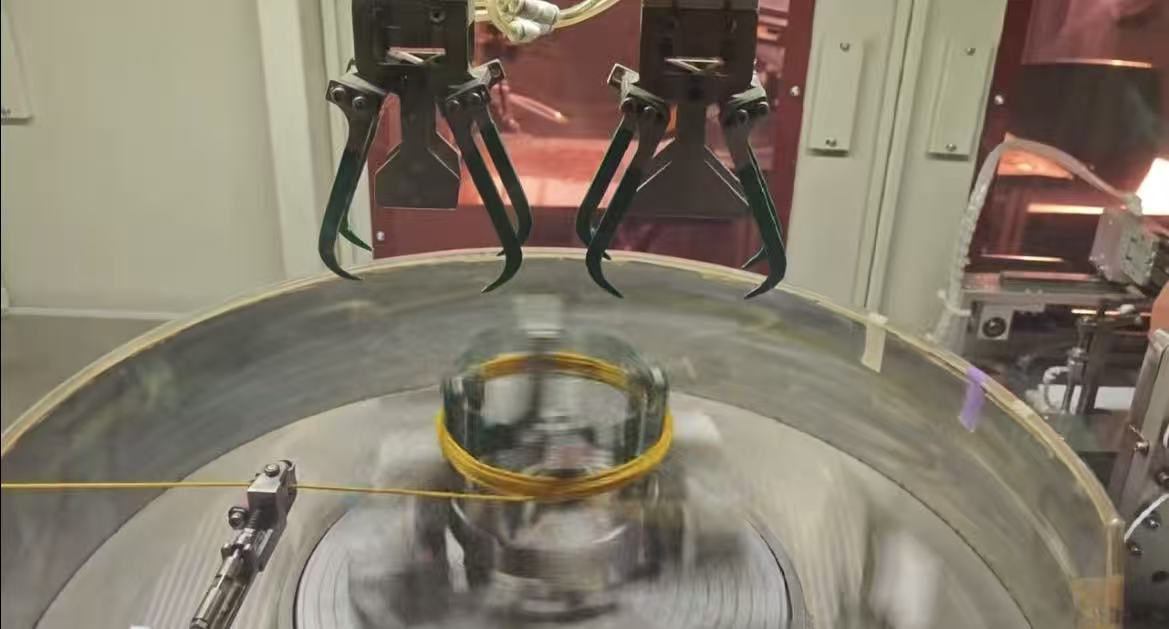



A fiber patch cord may look like a simple component, but every stable optical connection depends on precise manufacturing processes, advanced equipment, and strict quality control.
At SINDI, we focus on every detail — from fiber preparation to final inspection — to ensure reliable performance for telecom networks, FTTH deployments, and data center infrastructure.
1. Cable Preparation & Component Pre-Assembly
The process starts with accurate cable cutting according to customer requirements.
Before connectorization, essential components such as boots, springs, and crimp rings are precisely arranged and assembled in the correct sequence, preparing for the next production steps.
2. Fiber Stripping & Epoxy Injection
The cable jacket and fiber coating are carefully removed with precision tools.
High-quality epoxy resin is injected into the ferrule to ensure stable fiber fixation and long-term reliability.
3. Fiber Insertion & Curing
The bare fiber is carefully inserted into the ferrule hole and cured under controlled temperature conditions.
This step ensures accurate fiber positioning and provides a strong foundation for optical performance.
4. Fiber Cutting & Four-Step Precision Polishing
After the curing process, the excess fiber is carefully removed before entering the precision polishing stage.
To achieve a high-quality optical connector end face, each ferrule undergoes a four-step polishing process, with each stage serving a specific purpose:
① Glue Removal – 30μm Silicon Carbide (SiC) Film
The first step removes excess cured epoxy resin from the ferrule end face and levels the protruding fiber. This creates a smooth foundation for the following polishing stages.
② Rough Grinding – 9μm Diamond Film (D9)
The rough grinding process shapes the ferrule spherical geometry, removes deeper scratches from the initial step, and forms the basic 3D end-face profile.
③ Fine Grinding – 1μm Diamond Film (D1)
The fine grinding stage eliminates rough grinding marks, improves surface precision, and controls fiber height and fiber undercut/exposure to prepare for final polishing.
④ Final Mirror Polishing – ADS / Cerium Oxide Polishing Film
The final polishing step creates a mirror-like end face by removing microscopic scratches and improving surface smoothness, helping achieve low optical loss and high return loss performance for PC/UPC connectors.
Through a controlled four-step polishing process, we ensure consistent connector geometry, excellent optical performance, and long-term connection reliability.
5. Connector Assembly & Crimping
The connector components are assembled and securely crimped to enhance mechanical strength.
The crimping process improves pull resistance and ensures the cable and connector remain firmly connected during installation, transportation, and long-term operation.
6. 3D Interferometer Testing
Every connector end face is precisely inspected through 3D interferometer testing, including:
Radius of curvature
Apex offset
Fiber height
These parameters directly influence connector alignment accuracy and optical performance.
7. Optical Performance Testing
Each patch cord undergoes optical testing to verify:
✔ Insertion Loss (IL)
✔ Return Loss (RL)
Ensuring stable signal transmission and meeting industry requirements.
8. End-Face Inspection & Final Packaging
Using 400× magnification inspection, we check the cleanliness and quality of the fiber end face.
After passing all inspections, products are equipped with dust caps, carefully protected, packaged, and prepared for shipment worldwide.
A high-quality fiber patch cord is not only about connecting two devices — it is about ensuring reliable communication infrastructure.
Through precise manufacturing processes and strict quality management, we continue to provide dependable fiber connectivity solutions for customers around the world.
#FiberOptics #OpticalFiber #FiberPatchCord #FiberConnectivity #FTTH #Telecom #DataCenter #MPO #MTP #HighDensityCabling #OpticalNetwork #NetworkInfrastructure #FiberManufacturing #QualityControl #Telecommunications